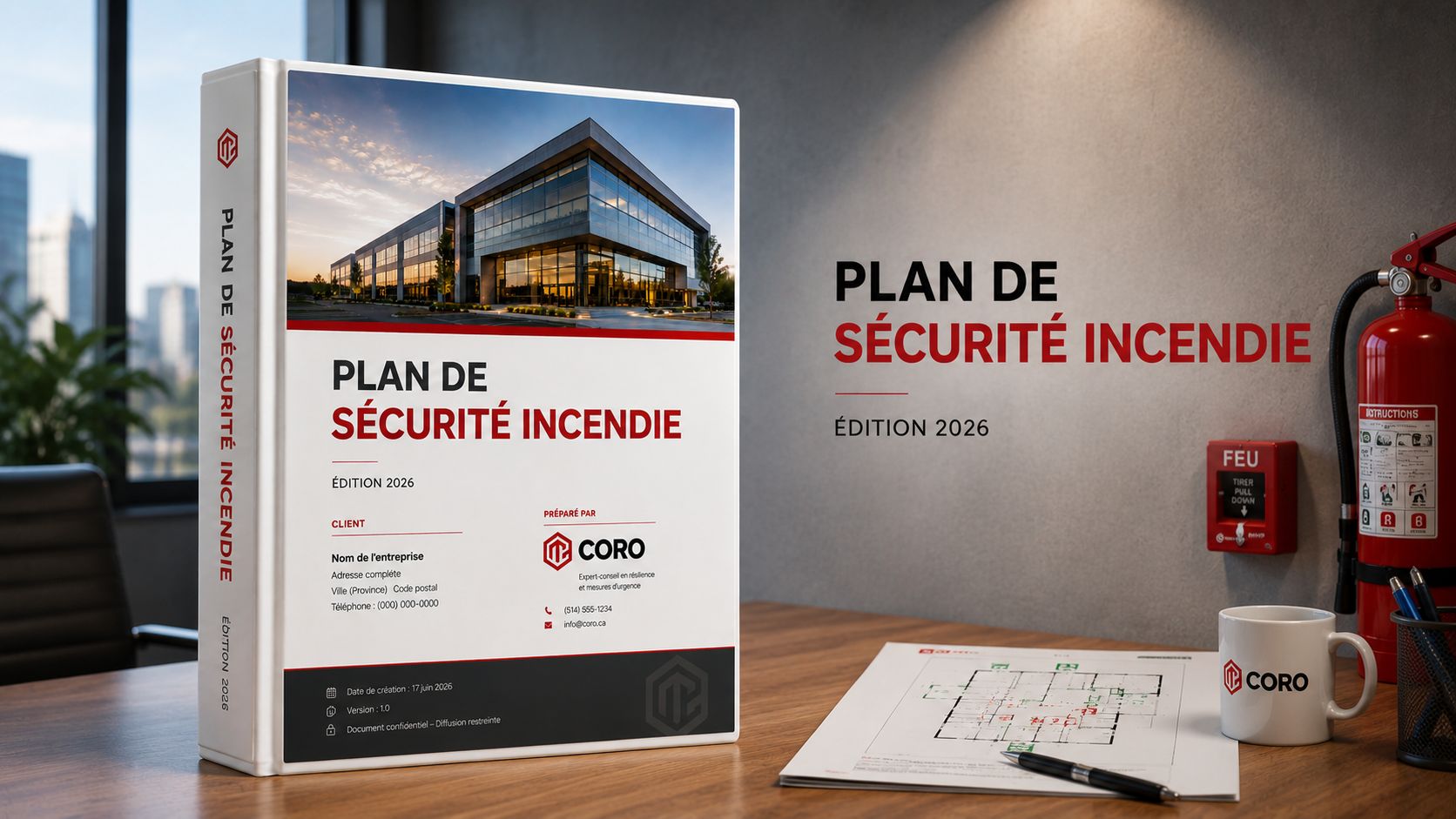
What Does a Fire Safety Plan (FSP) Contain?
A Fire Safety Plan (FSP) is much more than an evacuation diagram posted near an elevator or a short list of instructions to follow when the fire alarm sounds. It is a structured set of measures designed to prepare occupants and responsible personnel to respond effectively to a fire and to ensure that the building's fire-safety measures can be properly implemented.
In Quebec, the content of an FSP must be determined according to the requirements applicable to the building. Section 2.8 of the National Fire Code of Canada 2020, incorporated into the Quebec Safety Code with Quebec amendments, is a central reference for determining these measures.
A Fire Safety Plan Is Much More Than an Evacuation Plan
In practice, the term “Fire Safety Plan” is sometimes used to describe a very basic document containing emergency telephone numbers, a few instructions and evacuation diagrams.
A proper FSP goes much further.
It should make it possible to understand who does what, when and how when a fire emergency occurs. It establishes the measures to be implemented, assigns responsibilities, takes the characteristics of the building into account and documents the information required for preparedness and response.
The 2020 edition of the National Fire Code also reorganized and consolidated Fire Safety Plan requirements in order to facilitate compliance and enforcement.
Which Buildings Require a Fire Safety Plan?
It would be inaccurate to state that every building in Quebec requires exactly the same type of FSP.
The scope of fire emergency measures is established by Section 2.8 of the NFC, together with the amendments adopted in Quebec.
Quebec's amended provisions apply emergency-planning requirements to various buildings and situations covered by the Code. They notably extend the application to buildings equipped with a fire alarm system, whether that system is required or installed voluntarily.
Additional requirements may also apply to particular occupancies and building configurations, including certain care, treatment or detention occupancies, private seniors' residences, assembly occupancies and high buildings.
Important principle: before preparing an FSP, the first step is to determine which provisions actually apply to the building. The final content should never be determined solely from a generic template.
What Should a Fire Safety Plan Contain?
The exact structure depends on the building and the requirements that apply to it. An FSP developed around the provisions of the NFC will, however, generally address several major categories of information.
Actions to Be Taken in the Event of Fire
The FSP establishes the actions to be taken when a fire is discovered or when the fire alarm is activated, including alarm activation, notification of the fire department, instructions to occupants, evacuation and other measures appropriate to the building.
Roles and Responsibilities
The plan identifies the people or functions responsible for implementing the different measures. Depending on the building, these may include supervisory staff, evacuation personnel and individuals responsible for specific fire-safety functions.
Procedures for Occupants
Occupants should know how to respond to an alarm or the discovery of a fire. Instructions may vary depending on the occupancy, the building and the evacuation strategy in place.
Evacuation
The FSP establishes the measures used to move occupants to a safe location and considers exits, means of egress and the characteristics specific to the building.
Persons Requiring Assistance
The measures should account for occupants who may require additional assistance during an emergency when such provisions are applicable to the building and occupancy.
Fire-Protection Systems and Equipment
The plan should account for relevant systems and installations, including the fire alarm system, communication systems, smoke control systems, portable extinguishers, sprinkler systems, emergency equipment and other systems installed in the building.
Training of Supervisory Staff
People assigned responsibilities under the FSP must understand the measures established by the plan and be capable of carrying out the functions assigned to them.
Fire Drills
The FSP must be put into practice. Drills help verify the understanding of assigned roles, occupant response and the effectiveness of established procedures.
Control of Fire Hazards
The FSP also forms part of a broader prevention strategy by addressing identified fire hazards, maintaining safe conditions and applying measures intended to reduce the likelihood or consequences of a fire.
Inspection and Maintenance
Systems and equipment provided for occupant safety must be subject to the inspections, testing and maintenance required by the applicable provisions.
1. Actions to Take When a Fire Occurs
The operational core of an FSP is the set of measures that must be implemented when a fire is discovered or a fire alarm signal is received.
The plan should make it clear how the actions applicable to the building are to be carried out, including for example:
- activating or responding to the fire alarm;
- notifying the fire department;
- providing the necessary instructions to occupants;
- implementing the established evacuation measures;
- assisting persons who require additional support;
- implementing the responsibilities of supervisory staff;
- preparing for the arrival and support of the fire department.
An effective FSP therefore transforms regulatory requirements into clear and practical actions.
2. Supervisory Staff
Supervisory staff play a central role in many Fire Safety Plans.
The plan should clearly define the functions assigned to them and allow the people concerned to understand their responsibilities before an emergency occurs.
Depending on the characteristics of the building, these responsibilities may include fire alarm procedures, communications, evacuation, operation of certain systems, coordination of occupants and liaison with the fire department.
Important special case: Quebec's Safety Code contains additional requirements relating to supervisory staff in certain buildings equipped with a two-stage fire alarm system. Staffing levels, presence at the central alarm and control facility or fire alarm panel and required competencies must therefore be verified according to the provisions applicable to the building.
3. Building Plans and Technical Information
To be operationally useful, an FSP should also provide enough information to understand the building to which its procedures apply.
In a complete documentation package, this will generally include relevant information allowing users to identify:
- storeys and major areas of the building;
- exits and means of egress;
- major fire-protection systems and equipment;
- relevant alarm panels and control facilities;
- areas presenting specific fire hazards;
- access routes useful to emergency responders;
- information required to quickly locate an incident.
The amount and level of detail should be adapted to the building and the requirements applicable to it.
4. High Buildings Require Additional Measures
Not all Fire Safety Plans are identical.
High buildings provide a good example of why the plan must be adapted to the building.
Quebec amendments to the NFC require additional information in the Fire Safety Plans of high buildings, including matters relating to:
- training of supervisory staff in the use of the voice communication system;
- procedures governing the use of elevators;
- operation of smoke control systems and other emergency systems;
- instructions required by supervisory staff and the fire department concerning these systems.
This distinction illustrates why a universal FSP template is not sufficient: the document must reflect the actual systems and characteristics of the building.
5. The Copy Reserved for the Fire Department
A Fire Safety Plan is not merely an administrative document stored in the property manager's files.
The applicable provisions also require a copy to be available to the fire department.
In Quebec, for a high building, the copy reserved for the fire department must be kept at the central alarm and control facility. In other cases covered by the requirements, it must be kept at a location determined in cooperation with the fire department.
This requirement reinforces a fundamental principle: an FSP must be accessible when it is actually needed. Even a technically excellent document has limited operational value if it cannot be found during an emergency response.
6. Distribution, Posting and Accessibility
Portions of the Fire Safety Plan must also be communicated to the people concerned.
Fire-safety documentation may therefore include several levels of information: a complete master plan, instructions for supervisory staff, occupant instructions, posted information and the copy reserved for the fire department.
Producing a PDF and storing it in a shared folder is therefore not enough. Organizations must also consider how the information will be distributed, understood and accessed.
7. The FSP Must Be Adapted to the Building
Two office buildings may appear similar and still require substantially different Fire Safety Plans.
🏢 Occupancy
Building use, the number of occupants and their ability to evacuate influence the measures that must be established.
🔥 Fire-safety systems
Fire alarm configuration, sprinkler systems, communications and other systems directly influence procedures.
👥 Organization
Staffing available during the day, evening and night can significantly affect the operational structure of the FSP.
📐 Configuration
Building height, areas, exits, emergency access and physical configuration must all be taken into account.
This is why preparing an FSP should begin with the collection and validation of building information rather than the mechanical completion of a generic template.
8. Should an FSP Address Other Emergency Scenarios?
The FSP is primarily dedicated to fire safety.
An organization may nevertheless face many other events, including medical emergencies, major utility failures, gas leaks, hazardous material spills, flooding, security threats, severe weather and other disruptions.
These situations are more appropriately addressed through a broader multi-hazard framework such as an Emergency Response Plan (ERP).
See also: Emergency Response Plan (ERP)
The ERP and FSP may share certain information while maintaining different objectives and requirements.
9. How Often Should a Fire Safety Plan Be Updated?
A Fire Safety Plan is not a document that should be produced once and then left unchanged for several years.
The NFC requires the Fire Safety Plan to be reviewed at intervals not greater than 12 months to account for changes in the use and other characteristics of the building.
In practice, it is also appropriate to review the plan whenever a change occurs that may affect its content.
For example:
- changes in responsible personnel;
- changes in emergency contact information;
- major construction or renovations;
- changes to exits or means of egress;
- changes in occupancy;
- changes to a fire-protection system;
- new hazards or activities;
- lessons learned from a drill or an actual event.
10. Why Do Fire Safety Plans Become Outdated So Quickly?
The most common problem is not necessarily the quality of the Fire Safety Plan when it is first produced.
It is what happens after delivery.
A manager changes. A telephone number is updated. A tenant moves out. A floor is renovated. A procedure changes. A person assigned an emergency role leaves the organization.
The building continues to evolve while the document sometimes remains frozen in time.
Document compliance therefore does not end when the FSP is produced. The real challenge is keeping the plan aligned with the operational reality of the building throughout its lifecycle.
How CORO Structures a Fire Safety Plan
CORO approaches the FSP as a set of structured data, responsibilities, procedures and document components rather than as an isolated Word file.
Information relating to the building, fire-safety systems, responsible personnel, emergency teams and procedures can be centralized to facilitate both document production and ongoing maintenance.
This approach also makes it possible to reuse common information in other compliance documents where appropriate, while preserving the requirements specific to the Fire Safety Plan.
Discover Fire Safety Plan management with CORO:
In Summary: What Should a Good FSP Make Possible?
Beyond regulatory compliance, a sound Fire Safety Plan should allow an organization to quickly answer several fundamental questions:
- What should we do when the fire alarm activates?
- Who is responsible for each emergency function?
- How are occupants informed and evacuated?
- How do we assist people who require additional support?
- Which fire-safety systems must be operated?
- How is the fire department received and supported?
- Where can emergency information be found?
- Does supervisory staff actually understand its role?
- Does the plan still reflect the current reality of the building?
If these answers are difficult to find or depend only on the knowledge of a few individuals, the Fire Safety Plan probably deserves to be reviewed.
Structure and Maintain Your FSPs with CORO
Discover how CORO can transform the way you create, manage and maintain Fire Safety Plans and other compliance documents.
Request a Demo →Sources and References
- Quebec Safety Code — Chapter VIII, Building — Quebec provisions and amendments to the National Fire Code of Canada.
- National Research Council Canada — Quebec Safety Code, Chapter VIII – Building, and National Fire Code of Canada 2020 (amended)
- Quebec Safety Code, Chapter VIII: Building, and National Fire Code of Canada 2020 (amended) — NRC Publications Archive — including Section 2.8 on Emergency Measures and Fire Safety Plans.