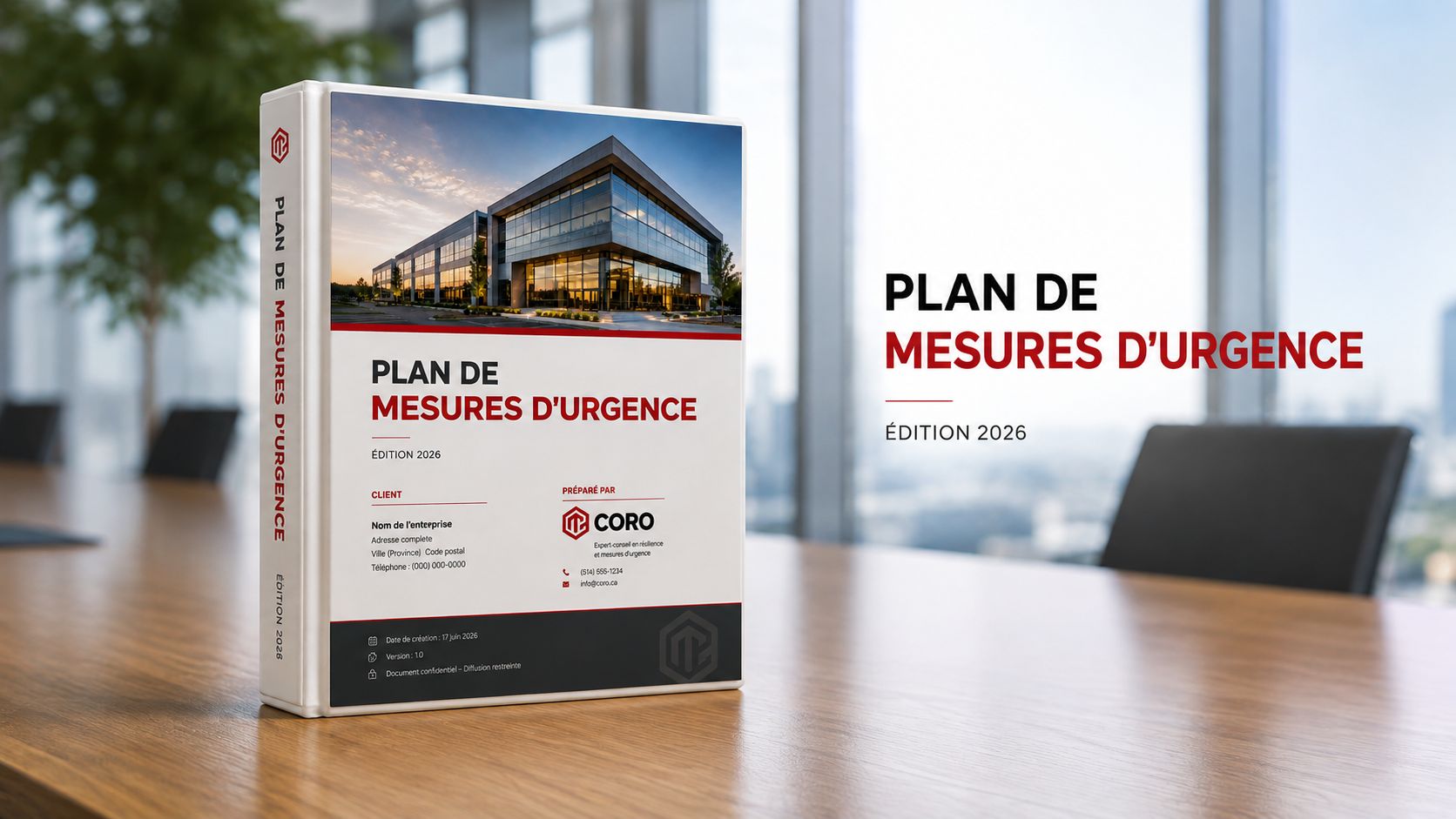
What is an Emergency Measures Plan (EMP)?
An Emergency Measures Plan (EMP) is a reference document that helps an organization structure its preparedness and response to emergency situations that may affect people, buildings, operations or the environment. Here is what an EMP contains, how it fits within Quebec’s regulatory framework and why it should not be confused with a Fire Safety Plan (FSP).
Definition of an Emergency Measures Plan
An Emergency Measures Plan (EMP) is a structured document that brings together the measures established by an organization to prepare for various events that may threaten people, property, operations or the environment.
It can define the responsibilities of emergency personnel, alert and mobilization mechanisms, response procedures, communication methods, evacuation or shelter-in-place strategies, and the resources available when an emergency occurs.
Depending on the risks specific to the building or organization, an EMP may address situations such as fire, gas leaks, hazardous material spills, medical emergencies, major power failures, flooding, extreme weather, suspicious packages, bomb threats, critical system failures or any other event relevant to the site.
Key takeaway: an EMP is not simply an evacuation plan. It provides an organizational framework that establishes who does what, when, how and with which resources when an emergency occurs.
Why should emergency planning begin with a risk assessment?
A sound Emergency Measures Plan should never be developed solely from a generic template.
Emergency planning should first consider the risks to which the building or organization is actually exposed. Two buildings of similar size may have completely different operational realities depending on their occupancy, activities, systems, hazardous materials, number of occupants and available on-site resources.
This assessment helps determine which emergency scenarios should be addressed and the level of preparedness required for each one.
🏢 Building characteristics
Occupancy, height, floor area, site configuration, safety systems and critical infrastructure.
👥 Building population
Employees, tenants, visitors, customers, people requiring assistance and variations in occupancy.
⚠️ Specific hazards
Hazardous materials, industrial processes, critical equipment, surrounding environment and specialized activities.
🛡️ Response capabilities
Available personnel, security resources, technical support, first aid, communications and external assistance.
EMP, evacuation plan and FSP: three different concepts
These terms are sometimes used as though they refer to the same document. Their scope, however, is different.
An evacuation plan primarily addresses the organization and procedures required to move occupants to safety when evacuation is necessary.
A Fire Safety Plan (FSP) specifically addresses fire prevention, preparedness, safety measures and emergency response, in accordance with the requirements applicable to the building.
An Emergency Measures Plan (EMP) generally has a broader scope because it may address multiple categories of emergencies identified according to the risks specific to the site.
EMP
All-hazards approach
Overall organization of the response to the different emergency situations relevant to the building or organization.
FSP
Fire safety
Measures and procedures specifically related to fire prevention, preparedness and emergency response.
Within an integrated documentation structure, an organization may choose to incorporate its FSP into a master EMP. This documentation approach does not, however, alter the specific regulatory requirements that may apply to the Fire Safety Plan.
Learn more: Emergency Measures Plan (EMP)
See also: Fire Safety Plan (FSP)
What is the regulatory framework for an EMP in Quebec?
In Quebec, it is important not to present the EMP as a single standardized document that is legally required in exactly the same form for every organization.
Applicable obligations may arise from several acts, regulations, codes and sector-specific requirements depending on the nature of the establishment, its occupancy, the activities being carried out, the hazards present and the authorities having jurisdiction.
Several legal and regulatory instruments nevertheless play an important role in emergency preparedness.
Regulation respecting occupational health and safety (RSST)
Section IV of Quebec’s Regulation respecting occupational health and safety (RSST) specifically addresses safety measures in the event of an emergency.
Section 34 provides that an emergency evacuation plan must be established in every establishment and implemented where applicable.
Section 35 also requires rescue and evacuation exercises to be held at least once a year and adapted to the risks presented by the establishment and the nature of the activities carried out there.
Section 36 addresses portable fire extinguishers.
Important: these provisions establish specific emergency preparedness requirements in the workplace, but they should not be interpreted as a universal requirement for every establishment to produce a comprehensive EMP covering every possible emergency scenario.
Act respecting occupational health and safety (AOHS)
Section 51 of Quebec’s Act respecting occupational health and safety establishes the employer’s general duty to take the necessary measures to protect the health and ensure the safety and physical and psychological well-being of workers.
This duty includes, among other things, identifying, controlling and eliminating risks that may affect worker health and safety, as well as implementing fire safety measures prescribed by regulation.
Civil protection and disaster resilience
Since May 28, 2024, Quebec has been governed by the Act respecting civil protection to promote disaster resilience.
This legislation establishes an integrated approach to civil protection that includes risk awareness, disaster prevention, preparedness, emergency response and recovery.
It also reinforces the concept that civil protection is a shared responsibility among various members of society, including citizens, businesses and public authorities.
It does not, however, mean that every business in Quebec is automatically required to produce a document called an “EMP” according to a single standardized model.
What role does the NFC play in an EMP?
The National Fire Code of Canada 2020 (NFC 2020) plays an important role when an Emergency Measures Plan addresses fire safety.
In Quebec, Chapter VIII — Building of the Safety Code incorporates the NFC 2020 with amendments adopted by Quebec. This new edition of Chapter VIII came into force on April 17, 2025.
It is therefore more precise to refer to the NFC 2020 as amended for Quebec under Chapter VIII — Building of the Safety Code rather than treating the national model code as though it applied in Quebec without modification.
Section 2.8 of the NFC: Emergency Planning
The National Fire Code contains a section specifically dedicated to emergency planning.
Where the applicable provisions require it, this section addresses fire emergency planning, responsibilities assigned to supervisory staff and procedures to be followed in the event of a fire.
This is the context in which the Fire Safety Plan (FSP) should be understood: it has its own foundation and requirements related specifically to fire safety.
EMP and FSP are therefore not interchangeable. An organization may combine them within a common documentation structure, but incorporating an FSP into an EMP does not eliminate the specific fire safety requirements applicable to the building.
What does a complete EMP contain?
There is no single EMP template that is appropriate for every organization. Its content should reflect the characteristics of the site, the risk assessment, available resources and applicable requirements.
A professional Emergency Measures Plan will nevertheless generally include several essential components.
1. Description of the building or organization
The EMP should provide the information necessary to quickly understand the operational context: address, occupancy type, floor area, number of storeys, occupancy hours, building characteristics, safety systems, critical infrastructure and site-specific considerations.
2. Risk assessment
Reasonably foreseeable events should be identified based on their likelihood, potential consequences and the characteristics of the organization.
This process helps ensure that the procedures included in the EMP are relevant rather than automatically applying the same emergency scenarios to every building.
3. Emergency management structure
The EMP should clearly identify the functions that will be mobilized when an emergency occurs and describe their responsibilities.
Depending on the organization, this structure may include an emergency coordinator, supervisory staff, evacuation personnel, a first-response team, technical personnel or other functions adapted to the site.
4. Alert and mobilization mechanisms
The document should specify how an emergency is reported, who must be notified, who mobilizes the emergency team and how communications are transmitted to occupants, internal stakeholders and emergency services.
5. Emergency procedures
Each identified risk should be associated with a procedure that is clear enough to be implemented under actual emergency conditions.
- Fire and evacuation
- Medical emergency
- Gas leak
- Hazardous material spill
- Power failure or critical system failure
- Flooding
- Extreme weather
- Suspicious package or bomb threat
- Situation threatening occupant safety
- Any other scenario relevant to the site
6. Evacuation, shelter-in-place and protective actions
Not every emergency requires the same protective strategy.
Depending on the scenario, it may be necessary to conduct a full or partial evacuation, shelter occupants in place, direct them to a safer area or implement other protective measures.
7. People requiring additional assistance
Emergency planning should consider people who may require assistance during an emergency and establish measures appropriate to the building, its occupants and the resources available.
8. Emergency resources and equipment
The EMP should identify resources that may be required during an emergency, including communication systems, first-aid equipment, protective equipment, emergency response equipment, technical installations and specialized resources.
9. Emergency contact information
Responsible personnel should have rapid access to contact information for emergency services, managers, technical personnel, specialized contractors, authorities and other relevant resources.
10. Training and exercises
A plan that nobody understands has limited operational value.
People assigned emergency responsibilities should understand their roles, and procedures should be exercised so that discrepancies between the written plan and actual operations can be identified.
In establishments subject to the RSST, rescue and evacuation exercises must notably be conducted at least once a year and adapted to the risks present and the nature of the activities.
How often should an EMP be updated?
An Emergency Measures Plan should be considered a living document.
A review should notably be triggered whenever a change affects:
- the hazards present in the building;
- operations or processes;
- occupants or tenants;
- people assigned emergency responsibilities;
- contact information and external resources;
- building layout;
- safety systems or critical equipment;
- evacuation or shelter-in-place strategies;
- procedures following an exercise or an actual emergency.
An annual revision date alone is therefore not enough if operational information has changed in the meantime.
Does an EMP have to comply with CSA Z731?
CSA Z731 — Emergency Preparedness and Response is a recognized standard in the field of emergency preparedness and response.
It can provide a useful framework for structuring an emergency preparedness program, and certain sector-specific regulatory frameworks may reference it.
It would nevertheless be inaccurate to state that CSA Z731 automatically constitutes a general legal requirement for every EMP developed in Quebec.
Good practice: organizations should always verify the acts, regulations, codes, contractual standards and requirements of the authority having jurisdiction that specifically apply to their building and activities.
Why must an EMP reflect real-world operating conditions?
The quality of an Emergency Measures Plan should not be measured by the number of pages it contains.
It should instead be measured by its ability to provide reliable information and understandable actions to the people who will be required to respond when an emergency occurs.
A building with a permanently staffed command post does not have the same emergency response structure as a facility occupied by a small team. A multi-tenant office tower does not present the same risks as an industrial facility that handles hazardous materials. A healthcare facility must also consider occupants who may not be able to evacuate independently.
The EMP should therefore be built around the operational reality of the site, rather than forcing the site to fit a generic emergency plan.
How CORO simplifies EMP production and management
CORO helps structure the production and management of compliance documents based on information specific to the building and the mandate.
The platform can centralize site information, structure emergency procedures, manage the documentation process, track versions and approvals, and produce the deliverables associated with the mandate.
For professionals and consulting firms managing multiple buildings, CORO also provides a common environment for projects and compliance documents instead of relying on scattered files, versions and separate tracking tools.
Discover CORO
Discover how CORO can transform the way you create and manage your compliance documents.
Request a demo →Sources and references
- Regulation respecting occupational health and safety (RSST) — including sections 34 to 36 concerning emergency safety measures.
- Act respecting occupational health and safety — including section 51 concerning the employer’s general duties.
- Act respecting civil protection to promote disaster resilience — chapter S-2.4.
- Régie du bâtiment du Québec — Update to the Construction Code and Safety Code — new Chapter VIII — Building came into force on April 17, 2025.
- National Fire Code of Canada 2020 — including Section 2.8 on emergency planning.
- Régie du bâtiment du Québec — Explanatory guide to Quebec amendments to the NFC 2020
- CSA Z731 — Emergency Preparedness and Response