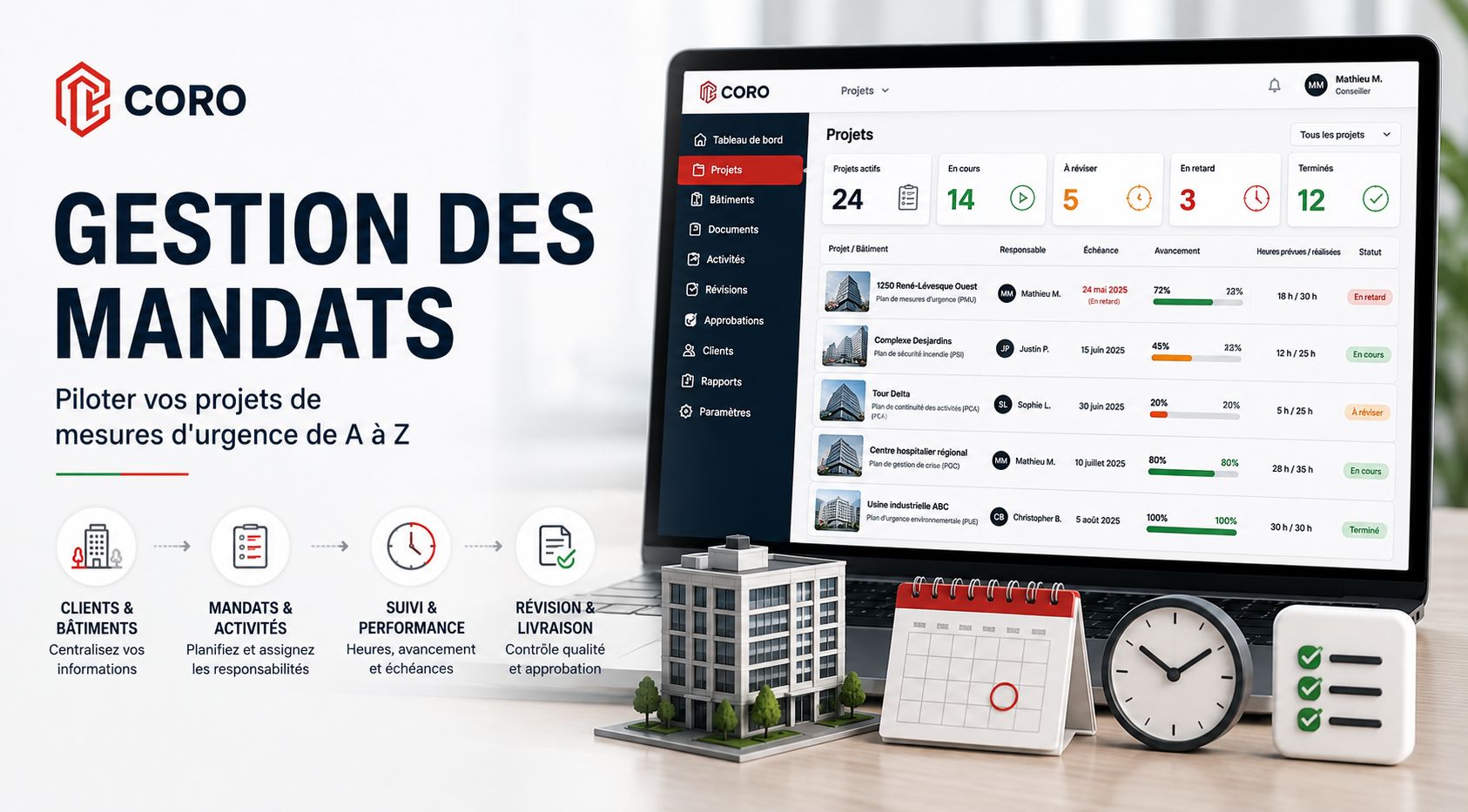
Producing an Emergency Response Plan (ERP), Fire Safety Plan (FSP) or another compliance document is only one part of a professional mandate. Before reaching the final document, teams must coordinate the client, building, activities, responsibilities, deadlines, planned and actual hours, document production, reviews and delivery. When several mandates are running simultaneously, managing them becomes an operational challenge in its own right.
An Emergency Management Mandate Is First and Foremost a Project
When an organization hires a professional to produce or update an emergency management document, the expected result is generally a deliverable: an ERP, an FSP or another specialized plan.
Behind that document, however, is a complete project involving multiple stages, stakeholders and decisions.
The challenge is therefore not simply to produce a good document. Teams must also know where the mandate stands, what remains to be completed, who is responsible for each activity, which deadlines are approaching and how many resources have already been consumed.
The document is the deliverable. The mandate is the process required to get there. Effective management must therefore cover the entire cycle, from project kickoff to final delivery.
Why Does Managing Mandates Become More Complex as Volume Increases?
Managing a few mandates simultaneously may seem relatively simple. A consultant knows their files, upcoming deadlines and the actions that need to be completed.
This approach can quickly reach its limits as the number of mandates grows or when several people begin working on the same projects.
Teams must then be able to answer practical questions quickly:
- Which mandates are currently active?
- Which projects are approaching their deadlines?
- Which projects or activities are overdue?
- Who is responsible for each activity?
- Which activities must be completed this week?
- How many hours were planned for the mandate?
- How many hours have actually been used?
- Which documents are being produced, reviewed or awaiting action?
- Which mandates require immediate attention?
When answering these questions requires consulting several spreadsheets, calendars, emails or separate applications, a significant amount of management time is spent searching for and reconstructing information.
The Problem Is Not Always a Lack of Tools
Most organizations already use several digital tools. A spreadsheet may track hours, a calendar may manage deadlines, an email inbox may preserve communications and a shared drive may store documents.
Each of these tools may be perfectly suited to its individual purpose. The difficulty appears when information related to the same mandate is distributed across multiple environments that do not share the same operational context.
Deadlines
Important dates may be known without necessarily being connected to the actual progress of the mandate.
Hours
Actual hours may be recorded without being directly compared with the progress of the project.
Documents
Files may be centralized without automatically reflecting their production, review or approval status.
Responsibilities
Team members may know their own tasks without having a complete view of the mandate.
The real challenge is therefore often not the availability of information, but the relationship between all of that information.
Centralizing the Mandate Around the Client and Building
In emergency management, the building represents an especially important source of context. Multiple mandates, documents and activities may be associated with the same site over time.
A structured approach makes it possible to connect the mandate to its operational environment rather than treating every project as an isolated file.
This structure supports continuity of information. When a new mandate is performed for a building that is already known, the professional can work within the same environment instead of systematically rebuilding the site's context.
Plan Activities Before Document Production Begins
A final delivery date is not always enough to manage a mandate effectively.
Between project kickoff and closure, several activities may need to be completed. Depending on the scope of the mandate, these may include:
-
Project kickoff
Create the project, associate it with the client and building, and establish the scope of work. -
Information collection
Gather existing documentation and the information required to complete the mandate. -
Site assessment and analysis
Validate building characteristics, systems, hazards and the emergency management organization. -
Document production
Create or update the ERP, FSP or other document included in the mandate. -
Quality control and review
Verify the content, process observations and complete the required corrections. -
Approval and delivery
Finalize the document and deliver it to the client.
When these activities are planned from the beginning, the mandate becomes significantly easier to monitor and manage.
Assign Responsibility and a Deadline to Every Activity
An activity appearing on a task list is not necessarily an activity that is truly being managed.
To make it operational, teams should ideally be able to identify at least what needs to be done, who is responsible and when it is due.
This becomes particularly important when several people are involved in a mandate, such as a lead consultant, another team member responsible for part of the work, and a reviewer or approver.
Structured responsibility management reduces grey areas and allows each team member to understand what is expected without reconstructing the assignment from email exchanges.
Track Planned Hours Versus Actual Hours
Time is one of the most important resources for a professional services firm.
However, knowing the total number of hours spent only after a mandate has been completed is often too late to correct an overrun.
The information becomes much more useful when planned and actual hours can be compared while the project is still underway.
In this example, 60% of the planned hours have already been consumed. That figure becomes much more meaningful when compared with the actual progress of the mandate.
If the project is nearly complete, the situation may be perfectly normal. If only 40% of the mandate has been completed, the same figure becomes an indicator that may justify intervention before the project is finished.
Time tracking should not simply explain what happened after the fact. When used during the mandate, it can help identify potential variances early enough to take action.
Visualize the Progress of the Entire Mandate Portfolio
For a consultant, understanding the status of individual projects is important. For a manager, the challenge is broader: the entire portfolio of mandates must be understood.
A consolidated view can provide visibility into:
- active projects;
- activities in progress;
- upcoming deadlines;
- overdue activities or mandates;
- the progress of each project;
- assigned responsibilities;
- planned and actual hours.
This level of visibility helps organizations move from primarily reactive management toward a more proactive approach.
Connecting Mandate Management With Document Production
Project management becomes even more valuable when it is not separated from production of the actual deliverable.
In CORO, project and mandate management operates within the same environment as document production and compliance management .
The project is therefore more than a line in a tracking table. It can be connected to the client, building, activities and document that represents the final deliverable.
This continuity helps preserve the operational context surrounding the document throughout its production lifecycle.
Why Not Simply Use General-Purpose Project Management Software?
General-purpose project management platforms can be extremely powerful. They are designed to manage a wide range of projects, teams and working methods.
The question is therefore not whether they can manage tasks, deadlines or responsibilities. They can.
The difference lies in the industry-specific context.
A general-purpose platform understands the project. A specialized platform can also understand the client, the building, the document type, its production workflow, its approvals and its delivery lifecycle.
For teams that regularly produce emergency management and compliance documents, this connection between operational project management and the deliverable can reduce the need to maintain two separate environments: one for managing the mandate and another for producing the document.
Continuity From the Consultant to the Client
A mandate does not necessarily end when the consultant completes the first version of a document.
The document may need to undergo internal review, corrections and approval before being submitted to the client. The client may then review the document, return it with observations, request corrections and receive a revised version for another approval cycle.
This review process is part of the mandate as well.
CORO extends this workflow to the client portal , helping maintain continuity between mandate production, internal review, client review, corrections and final approval.
Project Management Also Creates Management Data
When activities, hours, deadlines and progress are structured within the same environment, they also become a source of operational information.
Organizations can then begin asking different questions:
- Which types of mandates consume the most hours?
- Which projects remain within their planned hours?
- Where are the most significant variances appearing?
- What is the team's current capacity?
- Are production objectives being achieved?
- How can available resources be allocated more effectively?
This is where project management begins to evolve into performance management.
CORO brings these indicators together within its Performance & Objectives environment, which represents the next logical stage in the mandate management cycle.
An Operational Chain Rather Than a Collection of Tools
The objective of a specialized platform is not necessarily to replace every tool already used by an organization.
Its purpose is to centralize the information that needs to remain connected throughout the mandate.
This approach makes it possible to view the mandate as a complete operational cycle rather than a series of disconnected tasks.
FAQ — Emergency Management Mandate Management
What is an emergency management mandate?
An emergency management mandate may include analyzing a building or organization, collecting information, producing or updating documents, reviewing content, completing corrections and delivering the final material to the client. Depending on its scope, several people and activities may be involved.
Why track hours while a mandate is still underway?
Tracking hours during the mandate makes it possible to compare resources already consumed with the work actually completed. A potential overrun can therefore be identified before the project is finished rather than only when it is closed.
Can project management software manage an ERP project?
Yes. A general-purpose project management platform can manage tasks, deadlines and responsibilities. A specialized platform such as CORO adds the operational context of the mandate, including the client, building and document-production process within the same environment.
Can several buildings be managed for the same client?
Yes. An organization may have several buildings and multiple mandates. Structuring information around the client and its buildings helps preserve continuity between projects, activities and documents.
Does the mandate end when the document has been produced?
Not necessarily. Depending on the organization's workflow, the document may still need to undergo internal review, corrections, client review, additional revisions, approval and final delivery.
What is the difference between project management and performance management?
Project management focuses primarily on organizing and monitoring work currently underway. Performance management uses the data generated by those mandates — including hours, progress and capacity — to analyze results and support operational decision-making.
Manage Your Mandates With CORO
Centralize projects, buildings, activities, deadlines, responsibilities and hours in the same environment as your compliance documents, from project kickoff through review, approval and final delivery.
Discover CORO Project Management