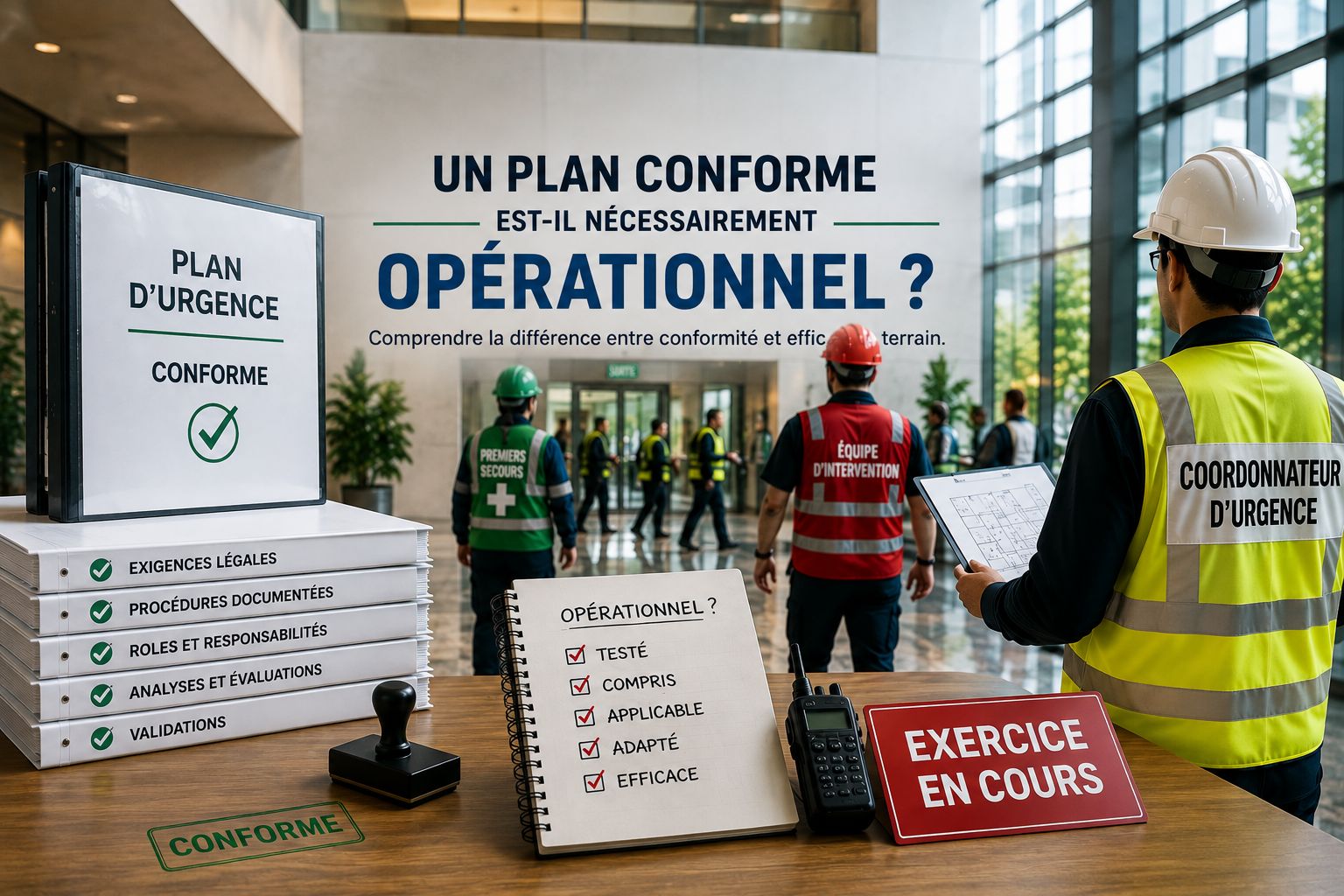
Does a Compliant Plan Mean You're Actually Prepared?
Every organization has an emergency plan. Far fewer organizations have the capacity to execute it effectively when a crisis unfolds in ways no one anticipated. This is the fundamental difference between document compliance and operational readiness.
The question is not: "Do we have a plan?"
The question is: "Can we execute that plan under
pressure, with incomplete information, when normal systems are
disrupted?"
What Compliance Guarantees — and What It Doesn't
A compliant emergency response plan or fire safety plan guarantees that your document meets applicable regulatory requirements: structure, content, signatures, annual review. That is a necessary condition. It is not a sufficient one.
Document compliance does not answer these questions:
- Do designated personnel actually know their roles?
- Do procedures reflect changes that occurred in the building since the last revision?
- Are emergency contact details current?
- Did night-shift staff receive the same training as day-shift employees?
- Have occupants requiring assistance been identified and their evacuation procedures adapted?
- Are safety equipment locations known to staff and equipment in working order?
These questions can only be answered through exercises, training and continuous plan maintenance.
What Regulations Require for Exercises
Quebec and Canadian regulations impose clear obligations regarding exercises — obligations that are often underestimated or misunderstood.
Regulation respecting Occupational Health and Safety (ROHS)
Section 35 of the ROHS requires that rescue and evacuation drills be conducted at least once a year in every establishment. These drills must be adapted to the hazards present in the establishment and to the nature of activities carried out there.
National Fire Code of Canada (NFC 2020)
The NFC, in force in Quebec since April 17, 2025 through the Quebec Safety Code, Chapter VIII — Building, also requires annual evacuation drills for applicable buildings. Section 2.8 specifies obligations for supervisory staff training, evacuation drills and FSP review at intervals not exceeding 12 months.
Environmental Emergency Regulations (2019)
For facilities subject to the Environmental Emergency Regulations (SOR/2019-51) under CEPA, simulation exercises are also mandatory. A comprehensive simulation exercise requiring the deployment of equipment and resources must be conducted within five years of the Environmental Emergency Plan coming into effect.
Key point: exercises are not an optional best practice. They are a regulatory obligation for the vast majority of organizations subject to emergency plans in Quebec and Canada.
What Exercises Reveal That Documents Cannot
A well-conducted exercise does not serve to confirm that a document is correctly written. It serves to determine whether the organization can actually execute it.
Exercises frequently reveal gaps that documents cannot identify:
⚡ Unclear decision authority
Who decides first when two managers receive contradictory information? The document assigns roles, but the exercise reveals areas of ambiguity.
📡 Communication failures
Do planned communication chains actually work under pressure? Are contact numbers current? Has radio equipment been tested?
🏢 Undocumented dependencies
Certain critical systems or suppliers were not integrated into the plan. The exercise surfaces them before a real emergency does.
👥 Overlapping responsibilities
Two responders think they are responsible for the same task — or no one is. The exercise clarifies these grey zones.
Quebec's Ministry of Health and Social Services (MSSS) states in its emergency management guides that simulation exercises must be organized periodically to familiarize personnel with procedures, identify operational gaps and optimize existing protocols.
Recognized Exercise Types
The Government of Canada's Emergency Management Planning Guide and the Government of Quebec's Introduction to Exercise Design guide distinguish several exercise types, each serving different objectives:
- Tabletop exercise: scenario simulation in a meeting room, without physical deployment. Ideal for testing decision-making processes and communications. Accessible, low-cost, highly informative.
- Functional exercise: simulation of one or two specific functions (e.g., alarm procedures, notification chain). Validates specific procedures.
- Full-scale exercise: comprehensive simulation with equipment and resource deployment. Tests the entire plan under near-real conditions.
- Evacuation drill: actual building evacuation, documented and timed. Mandatory annually under the ROHS and NFC for applicable establishments.
The Life Cycle of a Truly Operational Plan
An operational plan is not a document produced once and filed away. It is a continuous cycle:
📋 Production
Risk assessment, structured drafting, procedures adapted to the building, regulatory validation.
🎓 Training
Training designated personnel, informing occupants, training upon each change of key personnel.
🔄 Exercises
Mandatory annual exercises, documented results, identification of operational gaps.
✏️ Updates
Revision following exercises, building changes, personnel turnover or regulatory amendments.
The Government of Quebec, in its business continuity plan models, notes that plan components are not static elements — they must remain aligned with the organizational, operational and legislative reality in which the organization operates.
Personnel Training: An Often-Overlooked Obligation
Training is not optional. The NFC 2020 specifies that supervisory staff training is mandatory upon implementation or update of a fire safety plan (art. 2.8.1.2). The ROHS also requires that workers be informed of emergency measures applicable to their workplace.
In practice, this obligation raises concrete challenges:
- Did night and weekend staff receive the same training as day-shift employees?
- Are new employees trained upon arrival?
- Do commercial building tenants know their responsibilities?
- Have subcontractors present on site been informed of procedures?
- Is training documented and archived?
A common warning sign: during an evacuation drill, it is not uncommon to find that floor wardens designated in the plan are absent — because they changed positions, are on leave, or were never truly trained for their role. The plan accounts for everything. The organization cannot execute it.
What Real Incidents Reveal
GardaWorld Security, Canada's largest security services provider, observes in its field interventions that resilience depends on more than documented procedures. It depends on leadership, communication, coordination, training and preparedness that has been tested before it is needed.
Exercises often reveal unclear decision authority, overlapping communication responsibilities, inaccurate assumptions, undocumented technology dependencies and external partners who were not integrated into the response.
The goal of an exercise is not to catch teams off guard. It is to surface weaknesses and address them before a real incident does.
How CORO Supports Operational Readiness
CORO does not only produce compliant documents. The platform integrates the dimensions that transform a compliant plan into an operational tool:
- Revision tracking and alerts before regulatory deadlines
- Activity tracking module: planning and documentation of evacuation drills
- Emergency role and designated personnel management — with change history
- Client portal enabling building managers to access current documents
- Approval workflow ensuring no unvalidated document is distributed
Learn more: Emergency Response Plan (ERP)
From Compliance to Operational Readiness
Discover how CORO transforms your compliance documents into truly operational tools — with exercise tracking, role management and proactive alerts.
Request a demo →Sources and References
- Regulation respecting Occupational Health and Safety (ROHS) — art. 35 — annual rescue and evacuation drill requirement.
- RBQ — National Fire Code of Canada (NFC 2020) requirements — supervisory staff training and annual evacuation drills.
- Environment Canada — Simulation Exercises: Environmental Emergency Plan — exercise types and obligations under the Environmental Emergency Regulations (2019).
- MSSS — Emergency Measures Guide — simulation exercises to identify operational gaps.
- Government of Quebec — Business Continuity Plan Models — training and exercise program, continuous updates.
- Public Safety Canada — Guide to Emergency Management Planning — lessons learned from exercises, continuous improvement.
- GardaWorld Security — Emergency measures in Canada: the difference between having a plan and being prepared (July 27, 2026).