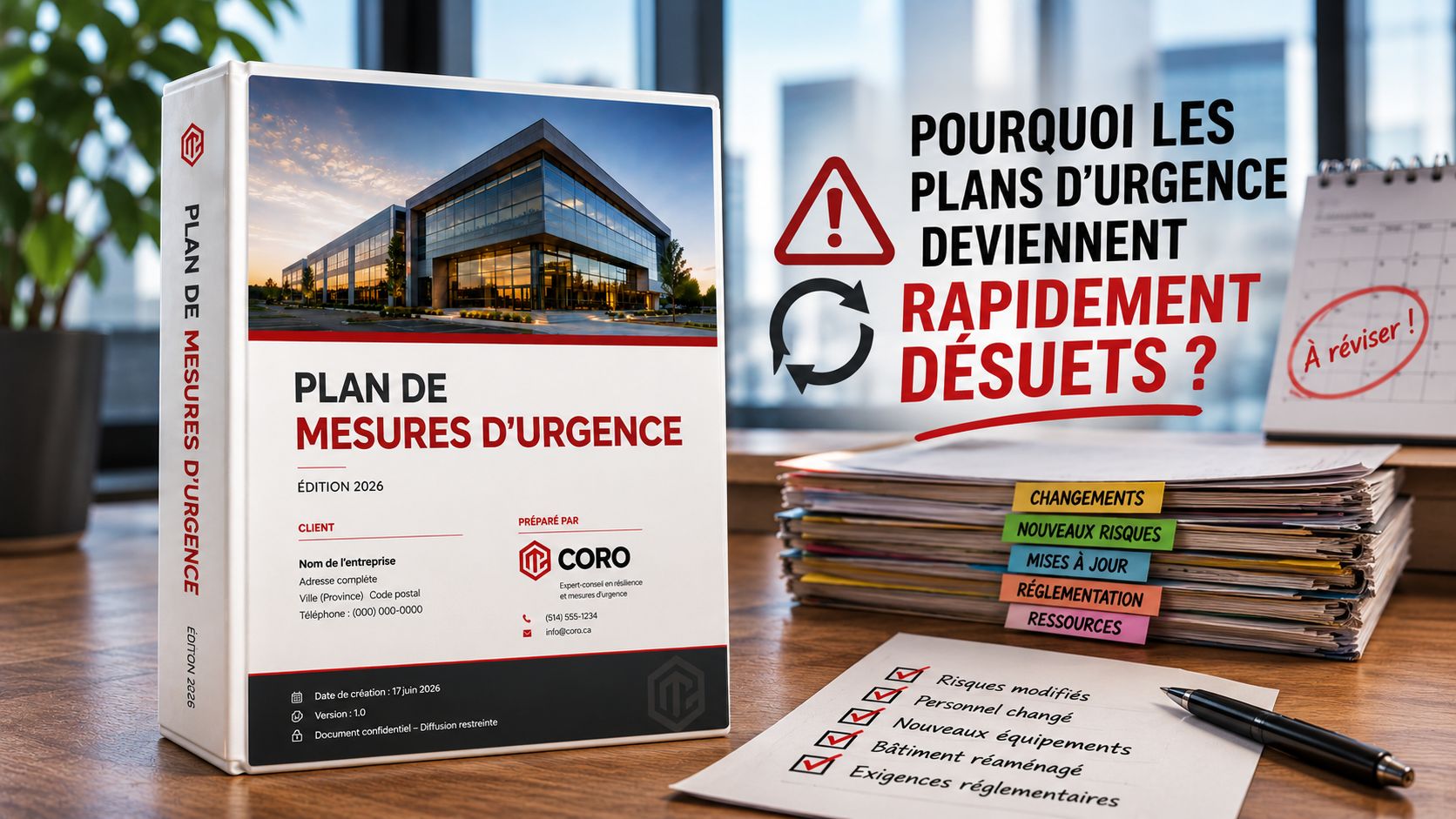
Why Do Emergency Plans Become Outdated So Quickly?
An emergency plan can be perfectly accurate on the day it is delivered and begin losing its value only weeks or months later. Buildings change, teams evolve, contact information is updated, systems are replaced and new risks emerge. Yet the document often remains exactly as it was on the day it was finalized.
The main risk associated with an emergency plan is not only that it may have been poorly designed. It is that a good plan may gradually stop reflecting the reality in which it will actually have to be used.
An Emergency Plan Is a Snapshot of an Environment That Keeps Changing
Preparing an Emergency Response Plan (ERP) or a Fire Safety Plan (FSP) requires a significant amount of information to be collected at a specific point in time.
This may include information about the building, its systems, occupants, responsible personnel, hazards, equipment, procedures, suppliers and available resources.
At the time the plan is delivered, all of this information may be completely accurate.
But the building does not stop evolving simply because the document has been finalized.
This is the fundamental challenge: an emergency plan is produced at a specific point in time, while the organization it describes is dynamic.
The 10 Most Common Causes of Outdated Emergency Plans
In practice, plans rarely become outdated because of one major change. More often, obsolescence results from an accumulation of smaller changes that gradually create a gap between the document and operational reality.
Responsible Personnel Change
Emergency coordinators, property managers, technical personnel, supervisory staff, security officers and emergency team members may change positions or leave the organization. Their names and responsibilities, however, sometimes remain in the plan for months.
Contact Information Becomes Incorrect
Telephone numbers, extensions, email addresses, suppliers and emergency contacts are among the easiest pieces of information to change — and among the easiest to overlook during document updates.
Occupants and Tenants Change
In commercial buildings, tenants move in, move out or relocate to different floors. Occupant numbers and activities may also change, affecting some of the assumptions used when the plan was originally prepared.
The Building Is Modified
Construction, renovations, new partitions, access changes, modifications to technical rooms or changes to circulation routes can make information, procedures or floor plans inaccurate.
Systems and Equipment Change
A fire alarm panel is replaced, an access-control system is modified, a new generator is installed or a communication system changes. The procedures associated with those systems must evolve accordingly.
New Hazards Appear
A new process, activity, piece of equipment, hazardous material or change in the surrounding environment may introduce risks that did not exist when the plan was originally prepared.
Operational Procedures Evolve
A procedure may change following a drill, an actual incident, an organizational change or simply because a more effective approach has been identified. The document should then reflect the new way of responding.
Applicable Requirements Evolve
Codes, regulations, standards and requirements from authorities may change. Organizations should periodically verify that their documentation remains aligned with the framework applicable to them.
Information Is Duplicated Across Multiple Documents
The more often the same information is copied into separate files, the greater the risk that only one version will be updated. Two documents may then contain different names, contact information or instructions for the same organization.
No One Truly Owns the Update Process
When responsibility for maintaining the plan is not clearly assigned, changes accumulate until the next major review. The document gradually becomes an archival product rather than an operational tool.
The Invisible Problem: Gradual Obsolescence
A document that is completely wrong is relatively easy to identify.
The real danger is often much more subtle.
A plan may still be 95% accurate while containing a small number of critical pieces of information that are no longer correct.
A single outdated telephone number, a responsible person who no longer holds the position or a procedure referring to a system that has been replaced may be enough to create confusion when every minute matters.
Document obsolescence is rarely dramatic. It develops gradually, one change at a time, until a drill or an actual emergency exposes the gap between the document and reality.
Why an Annual Review Is Not Always Enough
A periodic review is an excellent control measure, but it should not become the only mechanism used to keep emergency documentation current.
Imagine that the person responsible for emergency management leaves the organization in February and the plan is not scheduled for review until November.
For nine months, the plan may contain information that the organization already knows is incorrect.
A more effective approach combines a periodic review with event-triggered updates.
Which Changes Should Trigger a Review?
Organizations should be able to identify the events that require their emergency plans to be reviewed or modified.
- arrival or departure of someone assigned an emergency role;
- changes in contact information;
- a new tenant or significant occupancy change;
- major construction or renovations;
- changes to an exit or means of egress;
- installation or replacement of a critical system;
- a new hazard or activity;
- changes to suppliers or external resources;
- an applicable regulatory change;
- findings from an emergency drill;
- lessons learned following an actual emergency.
The best time to correct information is when it changes, not several months later simply because an annual review date has arrived.
Drills Are Also Document-Validation Tools
A drill is not only intended to determine whether occupants evacuate correctly.
It also provides an opportunity to test the plan itself.
Several questions can be asked:
- Were the people identified in the plan present and available?
- Did they understand their roles?
- Did the planned communication methods work?
- Was the contact information accurate?
- Was the equipment identified in the plan accessible?
- Did the procedures reflect the actual building conditions?
- Were any unanticipated situations identified?
Every drill can therefore become an operational quality-control exercise for the document itself.
Regulatory Requirements Also Reinforce the Need for Ongoing Validation
The need to maintain active emergency preparedness is also reflected in several regulatory requirements.
In Quebec, the Regulation respecting occupational health and safety (ROHS) notably requires rescue and evacuation drills to be conducted at least once a year and adapted to the risks present in the establishment and the nature of the activities carried out there.
In the field of fire safety, the National Fire Code of Canada as amended for Quebec also establishes fire-drill frequencies according to occupancy, with more frequent requirements applying to certain categories of buildings.
These requirements reinforce an important principle: an organization should not consider its preparedness complete when the document is produced. Preparedness must be maintained, exercised and reassessed.
The Problem with Independent Word and PDF Files
Word and PDF are not the problem in themselves. Both remain useful formats for producing, distributing and archiving documents.
The problem begins when the file becomes the only source of truth.
Consider a single property manager whose name appears in:
- the ERP;
- the FSP;
- emergency contact lists;
- emergency procedures;
- organizational charts;
- documents distributed to emergency teams;
- other compliance plans.
If that person is replaced, every affected file must be identified, opened, corrected, validated and redistributed.
If even one document is overlooked, multiple versions of reality can begin to coexist.
The Version-Control Problem: Which Document Is the Right One?
Another common challenge appears when multiple copies of the same plan are circulating.
There may be:
- a version stored on the organization's server;
- a copy previously sent by email;
- a PDF retained by the client;
- a printed copy at the security desk;
- an older version stored on a manager's computer;
- a document previously provided to an external stakeholder.
Once a change is made, the question becomes: how do you ensure that everyone is using the correct version?
Version control is therefore not merely an administrative issue. It can become an operational issue.
7 Signs That an Emergency Plan Needs to Be Reviewed
📞 Outdated contact information
Several names, telephone numbers or email addresses no longer correspond to the people currently responsible.
📅 An old review date
No one can clearly explain what was actually validated during the last update.
🏢 Building changes
Construction or renovations have occurred without a clearly documented review of the emergency plan.
👥 A different team
Several people identified in the procedures no longer work at the site.
📄 Multiple versions
Users cannot immediately identify which document is the official current version.
⚠️ New hazards
Operations have changed, but the emergency procedures remain unchanged.
🧪 Drills without follow-up
Issues identified during drills are not incorporated into the documentation.
How Can an Emergency Plan Remain Truly Operational?
Keeping a plan current is less about repeatedly rewriting the entire document and more about establishing effective information governance.
1. Assign an Owner
A person or function should be responsible for ensuring that relevant changes are identified and reflected in the documentation.
2. Identify Critical Data
Responsible personnel, contact information, systems, procedures, occupants requiring particular consideration and essential resources should receive particular attention.
3. Update Information When Changes Occur
Organizations should not systematically wait until the next annual review when important information has already changed.
4. Maintain a Change History
It should be possible to determine what changed, when it changed and in which version.
5. Validate the Plan After Drills
Findings from drills and actual incidents should be reviewed to determine whether procedures or information need to be adjusted.
6. Control Distribution
A new version only has value if the people who need it know that it exists and can access it.
From a Static Document to a Compliance Lifecycle
This is perhaps the most important shift in perspective.
An ERP or FSP should not be considered merely a deliverable.
It should be viewed as the visible result of a continuous compliance lifecycle:
1 — Observe
Understand the building, activities, people and hazards.
2 — Structure
Transform information into coherent roles, procedures and documents.
3 — Implement
Train, communicate and exercise the established measures.
4 — Verify
Identify gaps during drills and actual operations.
5 — Correct
Update data, responsibilities and procedures.
6 — Repeat
Compliance evolves with the organization and has no true endpoint.
ERPs and FSPs: Two Particularly Sensitive Examples
The Emergency Response Plan and Fire Safety Plan illustrate this challenge particularly well.
Both rely on operational information that is likely to change: responsibilities, occupants, systems, resources, procedures and building characteristics.
How CORO Addresses Document Obsolescence
CORO was designed around a simple principle: compliance should not be managed solely as a collection of independent files.
The platform makes it possible to structure and centralize the information used in compliance documents, manage projects and their different stages, track versions and approvals, and organize documents associated with buildings and mandates.
This approach facilitates initial document production, but its value becomes particularly important after delivery, when the organization, responsible personnel or building information begin to change.
The objective is not simply to produce a better document. It is to better manage the information that allows that document to remain relevant over time.
An Up-to-Date Plan Is, Above All, a Plan That Is Actively Managed
Emergency-plan obsolescence is not inevitable.
It occurs primarily when the compliance process stops at the moment of delivery.
An organization that clearly assigns responsibilities, monitors changes, uses drills to validate procedures, controls document versions and updates information as it evolves can significantly reduce the risk of its emergency plan becoming disconnected from operational reality.
The question should therefore no longer simply be:
“When was our emergency plan last updated?”
A much more useful question is:
“Does this plan still accurately reflect how our organization would operate if an emergency occurred today?”
The answer to that question is what truly determines the operational value of the document.
Let Your Documents Evolve with Your Organization
Discover how CORO can transform the way you create, manage and maintain compliance documents throughout their lifecycle.
Request a Demo →Sources and References
- Regulation respecting occupational health and safety — including provisions concerning emergency evacuation planning and rescue and evacuation drills.
- Quebec Safety Code — Chapter VIII, Building — incorporation of and Quebec amendments to the National Fire Code of Canada 2020.
- National Research Council Canada — Quebec Safety Code, Chapter VIII – Building, and National Fire Code of Canada 2020 (amended) — including Quebec requirements relating to Fire Safety Plans and their implementation.
- National Research Council Canada — National Fire Code of Canada 2020 — including provisions relating to emergency measures, Fire Safety Plans and fire drills.